Mazda CX-5 vs CX-50 – The Differences That Matter Most
The Mazda CX-5 vs CX-50 debate is heating up among SUV shoppers. Both models share the same Skyactiv platform and upscale interior feel, but they target different buyers. The CX-5 is the classic compact crossover focused on comfort and refinement, while the CX-50 brings a rugged, adventure-ready edge to the table. Understanding the key differences in design, price, performance, and features will help you make the right choice.
Choosing between two SUVs from the same brand can be tricky. When you look at the Mazda CX-5 vs CX-50, the differences might seem subtle at first glance. Both are stylish, well-built, and packed with features. But dig deeper, and you will find meaningful distinctions that affect your daily driving experience.
The Mazda CX-5 has been around for years. It is one of the best-selling compact SUVs in the world. The CX-50 is newer, and it was designed with a different purpose in mind. It targets buyers who want a more adventurous feel. Both share the same core engineering, but their personalities are quite different.
In this guide, we will break down every major difference. We will cover design, price, performance, interior space, technology, and more. By the end, you will know exactly which Mazda SUV fits your needs best.
Key Takeaways
- Platform Sharing: Both models use Mazda’s Skyactiv architecture, delivering solid driving dynamics and fuel efficiency.
- Design Divergence: The CX-5 is sleek and urban, while the CX-50 is rugged and off-road inspired.
- Price Gap: The CX-50 starts slightly higher, reflecting its rugged styling and added features.
- Interior Space: The CX-5 offers more rear passenger room, while the CX-50 provides a more rugged cargo setup.
- Target Audience: The CX-5 suits city drivers and families, while the CX-50 appeals to adventure enthusiasts.
- Reliability: Both models share Mazda’s strong dependability reputation, making either a smart long-term buy.
📑 Table of Contents
Design and Exterior Differences
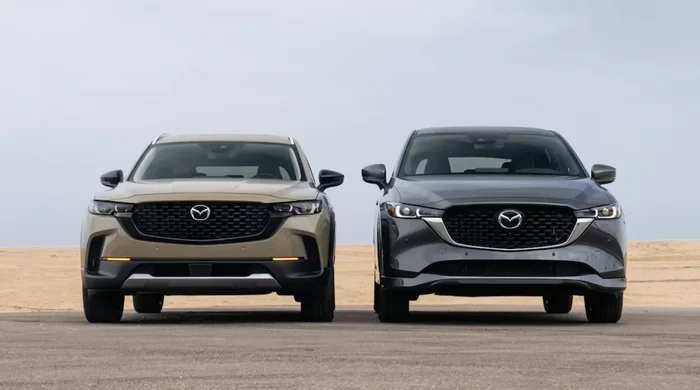
When you park a Mazda CX-5 next to a CX-50, you can tell they are related. But they are clearly built for different lifestyles. The CX-5 has a smooth, refined look that appeals to urban drivers. The CX-50 has a chunkier, more aggressive stance that screams adventure.
Mazda CX-5 Design Philosophy
The CX-5 follows Mazda’s traditional Kodo design language. It features sleek lines, a smooth hood, and elegant proportions. The front end has the signature Mazda grille with sharp LED headlights. The overall shape is aerodynamic and purposeful. It looks great in the city or on the highway.
The CX-5 comes in standard and Premium trims. The body is compact, making it easy to park in tight spaces. Its curb weight is lighter than the CX-50, which helps with fuel economy. The wheels are typically smaller, ranging from 17 to 19 inches depending on the trim.
Mazda CX-50 Design Philosophy
The CX-50 takes a completely different approach. It was introduced in 2022 as Mazda’s answer to the growing demand for rugged-looking crossovers. The front bumper is more bold, with larger air intakes. The body has more cladding and protective elements. The wheel arches are wider, and the standard wheels are bigger at 18 inches.
The CX-50 also sits slightly lower to the ground compared to the CX-5 in some trims, giving it a more planted look. There are exclusive exterior colors available on the CX-50 that you will not find on the CX-5. The overall impression is that of a vehicle ready to tackle trails, even if it is technically a road-focused crossover.
Quick Tip: If you live in a city and want easy parking, the CX-5 is the better choice. If you want a tougher look and occasional light off-roading, the CX-50 stands out.
Interior and Passenger Comfort
Inside, both the Mazda CX-5 and CX-50 feel upscale. Mazda uses quality materials in both models. Soft-touch surfaces, supportive seats, and a clean layout are standard. But there are important differences in space and comfort.
Rear Passenger Space
The CX-5 has more rear legroom than the CX-50. This is because the CX-50 has a slightly different roofline and a more rugged body structure. Adults in the back seat will appreciate the extra inches of space in the CX-5. For families with growing kids, this matters a lot.
The CX-50 rear seats are still comfortable. They are well-bolstered and have decent headroom. But taller passengers might feel a bit more cramped compared to the CX-5. If you regularly carry passengers in the back, the CX-5 has a clear advantage.
Cargo Capacity
Cargo space is another area where the two models differ. The CX-5 offers a generous trunk behind the rear seats. The CX-50 has slightly less cargo volume in the back, but it makes up for it with a more rugged load floor. Both models fold down the rear seats to extend the cargo area.
For most shoppers, the difference in cargo space is small enough that it will not be a dealbreaker. If you haul a lot of gear, consider testing both models with your typical load. The CX-5’s extra rear space can also help when you need to install child car seats or bulky items.
Interior Technology
Both models share the same infotainment system. The 10.25-inch touchscreen is sharp and responsive. Apple CarPlay and Android Auto come standard. Mazda’s interface is simple and intuitive, which is a big plus. Physical knobs for volume and climate control add to the ease of use.
Higher trims in both models get a Bose audio system, heated and ventilated front seats, and a head-up display. The interior quality of both vehicles is impressive for the price range. You will not find cheap plastics or awkward controls in either model.
Performance and Driving Experience
Under the hood, the Mazda CX-5 and CX-50 share the same engine options. This is one of the biggest similarities between the two. Both models come with a 2.5-liter four-cylinder engine as standard. The CX-50 also offers a turbocharged version in some trims.
Engine Specifications
The standard 2.5-liter engine produces around 187 horsepower and 186 pound-feet of torque. This is enough power for daily driving and highway merging. The engine pairs with a 6-speed automatic transmission. Both front-wheel drive and all-wheel drive are available.
The CX-50 turbocharged engine adds more punch. It delivers around 250 horsepower and 320 pound-feet of torque. This makes the CX-50 feel more spirited, especially when passing on two-lane roads. The CX-5 does not offer a turbo option in most markets, so this is a key differentiator.
Fuel Economy
Fuel economy is where the CX-5 has a slight edge. The lighter body and more aerodynamic design help it sip less gas. The CX-5 gets around 25 mpg in the city and 31 mpg on the highway with front-wheel drive. The CX-50 is close but slightly behind, at around 24 mpg city and 30 mpg highway.
Over time, these small differences can add up. If you drive a lot, the CX-5’s better fuel economy could save you money at the pump. But if you prefer the CX-50’s turbo power, the slightly higher fuel cost may be worth it.
Driving Feel and Handling
Mazda is known for building fun-to-drive cars. Both the CX-5 and CX-50 live up to this reputation. The steering is precise, and the chassis feels composed through corners. The suspension is well-tuned for comfort without being soft.
The CX-50 has a slightly firmer ride because of its rugged suspension setup. This is a trade-off for the more aggressive styling. On smooth highways, both cars feel refined. On rougher roads, the CX-50 handles bumps with more confidence.
Quick Tip: Test drive both back-to-back. The driving differences are subtle but noticeable. Pay attention to how each car handles your typical routes.
Price and Value Comparison
Price is one of the most important factors when choosing between these two SUVs. The Mazda CX-5 starts at a lower price point than the CX-50. This makes it an attractive option for budget-conscious buyers.
Starting Prices
The CX-5 base model starts around $28,000 in the US market. The CX-50 starts around $29,000. The gap is small, but it adds up as you move up the trim levels. Top-tier trims of both models can push past $40,000.
For buyers looking at the 5 to 8 lakh car range, the CX-5 typically offers more value for the money. The CX-50’s higher starting price reflects its unique styling and rugged features. But the difference is not huge, so it comes down to personal preference.
Which Offers Better Value?
The CX-5 delivers more standard features at a lower price. The CX-50 justifies its higher cost with exclusive styling and the turbocharged engine option. Both models hold their value well over time. Mazda vehicles have strong resale value compared to competitors.
If you want the best bang for your buck, the CX-5 is the safer choice. If you are willing to pay extra for the rugged look and turbo power, the CX-50 delivers a unique experience.
Safety and Reliability
Safety is a top priority for most SUV buyers. Both the Mazda CX-5 and CX-50 come packed with advanced safety features. Mazda’s i-Activsense suite includes automatic emergency braking, lane departure warning, and adaptive cruise control.
Both models earned top safety ratings from the IIHS. They also scored well in crash tests. The build quality is excellent, with strong body structures that protect occupants in collisions.
Reliability is another strength for both models. Mazda consistently ranks near the top of reliability surveys. Owners of both the CX-5 and CX-50 report few major issues. If you plan to keep your car for a long time, either model is a solid choice. Some owners who have driven a 5 year old car from Mazda report minimal mechanical problems.
Regular maintenance is straightforward for both models. Oil changes, brake pads, and tires are all reasonably priced. The cost of ownership is competitive with other brands in the compact SUV segment.
One thing to keep in mind is that older Mazda models sometimes face electrical issues. If you are considering a used model, a thorough inspection is always a good idea. Problems like a car turns over but won’t start can occasionally occur in older vehicles, but these are not specific to either the CX-5 or CX-50.
Which One Should You Choose?
The right choice depends on your lifestyle and priorities. Here is a simple breakdown to help you decide.
Choose the Mazda CX-5 if: You want maximum rear passenger space, better fuel economy, a lower starting price, and a refined urban look. The CX-5 is the all-rounder that handles most situations with ease.
Choose the Mazda CX-50 if: You want a rugged exterior, the turbocharged engine option, and a more adventurous feel. The CX-50 stands out from the crowd and brings a unique character to the table.
Both models are excellent vehicles. You cannot go wrong with either one. The decision comes down to what matters most to you. Visit a dealership, sit in both cars, and take them for a test drive. Your gut feeling will often guide you to the right answer.
Common Mistakes to Avoid
- Ignoring the test drive: Never buy based on specs alone. How a car feels behind the wheel matters more than numbers on paper.
- Overlooking total cost of ownership: The starting price is just the beginning. Factor in insurance, fuel, and maintenance costs.
- Skipping trim comparisons: The CX-50 turbocharged and CX-5 Premium trims offer very different experiences. Compare them carefully.
- Forgetting about resale value: Both models hold value well, but the CX-5’s broader appeal may give it a slight edge in the used market.
By avoiding these common pitfalls, you will make a confident and informed decision. Take your time, do your research, and trust the process.
Conclusion
The Mazda CX-5 vs CX-50 comparison shows two excellent SUVs with distinct personalities. The CX-5 is the refined, practical choice for families and daily commuters. The CX-50 is the rugged, stylish option for those who want something different. Both share Mazda’s commitment to quality, driving enjoyment, and reliability.
No matter which one you choose, you are getting a well-built vehicle that will serve you well for years. The key is understanding what you value most and matching it to the right model. We hope this guide has helped you see the differences clearly. Now it is time to go for a test drive and find your perfect Mazda.
Whether you prioritize space, performance, design, or value, there is a Mazda SUV that fits your life. The CX-5 and CX-50 both represent what Mazda does best: building cars that are fun to drive and pleasant to own.
Frequently Asked Questions
Is the Mazda CX-50 more expensive than the CX-5?
Yes, the CX-50 starts at a slightly higher price than the CX-5. The difference is typically around $1,000 to $1,500 at the base level. As you move up the trim levels, the gap can widen depending on the features and options you choose.
Can the Mazda CX-50 go off-road?
The CX-50 has a more rugged appearance and some off-road-ready features, but it is still primarily a road-focused crossover. It can handle light trails and gravel roads comfortably. For serious off-roading, a dedicated SUV or truck would be a better choice.
Which Mazda has better fuel economy, the CX-5 or CX-50?
The CX-5 has slightly better fuel economy thanks to its lighter weight and more aerodynamic shape. The difference is modest, usually around 1 to 2 mpg. If fuel economy is a top priority, the CX-5 gives you a small edge.
Are the interiors of the CX-5 and CX-50 the same?
They share the same infotainment system and many interior features. However, the CX-5 has more rear passenger space and a slightly different rear seat design. The front seats and dashboard are nearly identical between the two models.
Does the CX-50 come with a turbocharged engine?
Yes, the CX-50 offers a turbocharged 2.5-liter engine in certain trims. This engine produces around 250 horsepower, making it significantly more powerful than the standard 187-hp engine found in both the CX-5 and CX-50 base models.
Which Mazda SUV holds its value better, the CX-5 or CX-50?
Both models hold their value well. The CX-5 may have a slight advantage in the used market due to its longer history and broader appeal. However, the CX-50’s unique styling could also attract buyers looking for something different, helping it maintain strong resale value too.