Does Tesla Have Two Charging Ports And Why It Matters
Tesla vehicles use a single charging port, not two. This one port supports multiple charging methods, including Superchargers, home charging, and adapters for other networks. Understanding how the Tesla charging port works helps owners charge faster and avoid common mistakes.
Key Takeaways
- One Port, Many Options: Tesla uses a single charge port that works with Superchargers, home chargers, and adapters.
- Not All EVs Are the Same: Tesla’s proprietary connector differs from the J1772 standard used by most other electric vehicles.
- NACS Is Changing the Game: Tesla’s North American Charging Standard is becoming the industry-wide connector.
- Charging Speed Varies: DC fast charging at Superchargers is much faster than AC charging at home or destination chargers.
- Hybrids Work Differently: Unlike plug-in hybrids that switch to gas, Tesla relies entirely on electric power and a single charging port.
- Know Your Adapter: Using the right Tesla adapter unlocks access to non-Tesla charging networks and home outlets.
📑 Table of Contents
- What Kind of Charging Ports Does Tesla Use?
- So Does Tesla Have Two Charging Ports?
- Tesla Charging Port vs. Other EV Charging Standards
- How Fast Can You Charge a Tesla?
- Why Tesla Uses a Single Charging Port
- Tips for Tesla Owners and Buyers
- How Tesla Charging Compares to Hybrid Refueling
- The Future of Tesla Charging
- Conclusion
What Kind of Charging Ports Does Tesla Use?
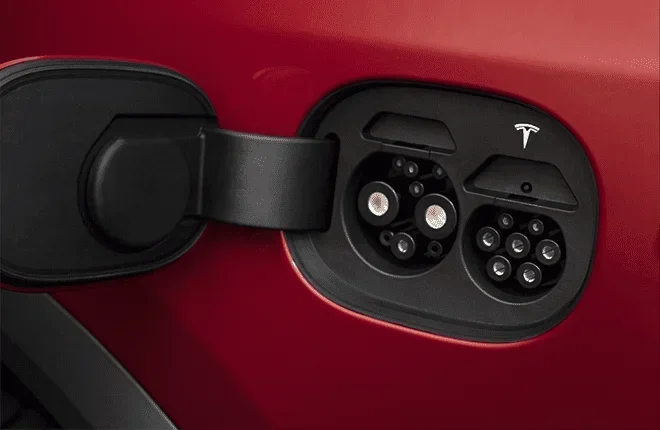
If you are new to the Tesla world, one of the first things you might wonder about is the charging port. Does Tesla have two charging ports? The short answer is no. Tesla vehicles use a single charging port located on the front left side of the car. This one port handles all charging needs, from overnight home charging to fast Supercharger sessions.
Tesla designed this single-port system to keep things simple. Instead of juggling multiple ports like some vehicles do, Tesla keeps it streamlined. One port. Many charging options. That is the Tesla way.
Where Is the Tesla Charging Port Located?
The charging port on a Tesla sits on the front left fender. It is behind a small door that pops open with a tap on the touchscreen or a press on the Tesla app. The location is consistent across all Tesla models, including the Tesla Model 3, Tesla Model Y, Model S, and Model X.
This placement is intentional. It keeps the port away from the rear bumper, where damage is more likely. It also makes it easy to plug in at most charging stations without awkward positioning.
Tesla’s Proprietary Connector
Tesla uses its own proprietary connector for charging. This connector handles both AC and DC charging, which is unique in the EV world. Most other electric vehicle brands need separate connectors for AC home charging and DC fast charging. Tesla combines both into one plug design.
The Tesla connector is compact and easy to handle. It locks into the port securely and communicates with the vehicle to manage charging speed automatically. This design has been a key part of Tesla’s charging advantage for years.
So Does Tesla Have Two Charging Ports?
The answer remains clear: Tesla has one charging port. But that single port does a lot of heavy lifting. Let us break down exactly how this works and why Tesla chose this approach.
One Port, Multiple Charging Methods
Even though Tesla has just one physical port, it supports several charging methods. Here is what a single Tesla charge port can handle:
- Mobile Connector: This comes with every new Tesla. It plugs into a standard home outlet for slow overnight charging.
- Wall Connector: Tesla’s home charging solution for faster speeds. It requires professional installation but delivers much more power than a standard outlet.
- Supercharger: Tesla’s network of DC fast chargers. These deliver the fastest charging speeds available for Tesla vehicles.
- Destination Chargers: Level 2 chargers installed at hotels, restaurants, and shopping centers.
- J1772 Adapter: Allows Tesla owners to use non-Tesla Level 2 public chargers.
That is a lot of capability from a single port. Tesla’s design means owners never need to worry about which port to use. There is only one, and it works everywhere.
How the Single Port Works
The Tesla charge port contains internal pins that communicate with the charger. When you plug in, the vehicle and charger negotiate the right power level. This happens automatically. You do not need to select a mode or press any buttons beyond plugging in.
The port also has a built-in heater. In cold weather, moisture can freeze inside the port, making it hard to plug in. Tesla added a thermal system that clears ice automatically, so you can charge without frustration even in winter.
Tesla Charging Port vs. Other EV Charging Standards
Understanding how Tesla’s single port compares to other EV standards helps explain why Tesla made this design choice. The EV charging world has several competing connector types, and Tesla’s approach stands out.
NACS and the Industry Shift
Tesla’s connector is now known as the North American Charging Standard, or NACS. In recent years, major automakers like Ford, GM, and Rivian have announced they will adopt NACS for their vehicles starting in 2025 and beyond.
This shift gives Tesla a significant advantage. The company built its Supercharger network years before other automakers invested heavily in public charging. Now, as other brands adopt NACS, Tesla’s charging infrastructure becomes even more valuable.
For owners, this means better access to chargers across the country. For the industry, it means one fewer connector type to manage. Simplicity wins again.
J1772 and Other Connectors
Most non-Tesla EVs in North America use the J1772 connector for AC charging. For DC fast charging, they typically use CCS (Combined Charging System). These are two separate connectors on the same vehicle.
Tesla uses just one connector that handles both roles. When you need to use a J1772 charger, a simple adapter plugs into the Tesla port. No extra port needed. This is one reason Tesla vehicles look so clean and uncluttered on the exterior.
Some people wonder if having two ports would be better. But the adapter system works well, and keeping a single port reduces weight, cost, and potential failure points.
How Fast Can You Charge a Tesla?
Charging speed is a top concern for EV owners. With only one charging port, you might wonder if Tesla limits your charging options. The good news is that Tesla’s single port supports very fast charging when you need it.
Supercharger Speed
Tesla Superchargers are the fastest way to charge a Tesla on the road. These DC fast chargers can add up to 200 miles of range in about 15 minutes, depending on the model and battery size.
Superchargers use the Tesla connector directly. No adapter is needed. Just pull up, plug in, and the car handles the rest. The charging speed adjusts automatically based on battery temperature and charge level.
Tesla continues to expand its Supercharger network across the country and around the world. V3 and V4 Superchargers deliver even faster speeds than earlier models, making road trips more convenient than ever.
Home Charging Speed
At home, charging speed depends on the equipment you use. A standard 120-volt outlet with the Mobile Connector adds about 3 to 5 miles of range per hour. That works for overnight charging but is slow for daytime top-ups.
A Tesla Wall Connector on a 240-volt circuit adds roughly 30 to 44 miles of range per hour. This is the sweet spot for most homeowners. You plug in when you arrive home and wake up with a full battery every morning.
For even faster home charging, some owners install a high-power Wall Connector setup. But for most daily driving, the standard Wall Connector is more than enough.
Public Charging Speed
When using non-Tesla public chargers with the J1772 adapter, speeds are limited to Level 2 rates, typically adding 20 to 30 miles of range per hour. These are great for destination charging when you are shopping or dining but not ideal for quick top-ups.
Tesla is also opening its Supercharger network to non-Tesla EVs using an adapter. This means the fastest charging speeds are no longer exclusive to Tesla owners, though the experience may vary for other brands.
Why Tesla Uses a Single Charging Port
Tesla’s decision to use one charging port instead of two is not arbitrary. There are clear engineering and design reasons behind this choice. Understanding these reasons helps explain why Tesla vehicles look and work the way they do.
Design Simplicity
Simplicity is a core Tesla principle. Every feature on a Tesla vehicle serves a purpose. Adding a second charging port would add complexity, cost, and potential failure points without meaningful benefit.
The single port design keeps the exterior clean and aerodynamic. It also reduces the number of parts that need maintenance or replacement over the life of the vehicle. Fewer parts mean fewer things that can go wrong.
How Hybrids Handle Refueling Differently
To understand why Tesla chose one port, it helps to look at how hybrid vehicles handle energy. A plug-in hybrid has two energy sources: a battery and a gas tank. The hybrid engine switches between them depending on driving conditions. At what speed a hybrid switches to gas depends on the battery charge level and how hard you are pushing the vehicle.
Because hybrids carry both electricity and gasoline, they need different refueling systems. A gas filler cap and a charging port are both necessary. Tesla, as a fully electric vehicle, only needs the charging port. There is no gas tank, so no second port is required.
This is a fundamental difference between EVs and hybrids. Tesla owners never visit a gas station. They charge at home, at work, or at Superchargers on the road. One port handles everything.
Weight and Efficiency
Every extra component adds weight to a vehicle. Weight reduces range and efficiency. By using a single port, Tesla keeps the vehicle lighter and more efficient. This translates to better range and better performance.
Tesla engineers constantly optimize every aspect of the vehicle for efficiency. The single charging port is a small but meaningful part of that optimization. It is a design choice that pays dividends in range and reliability.
Tips for Tesla Owners and Buyers
Whether you already own a Tesla or are considering one, a few practical tips can help you get the most from your single charging port.
Choose the Right Home Charger
The Tesla Wall Connector is the best option for home charging. It is fast, reliable, and designed specifically for Tesla vehicles. Installation costs vary, but many owners find the convenience worth the investment.
If you cannot install a Wall Connector, the Mobile Connector works with a standard outlet. Just know that charging will be slow. Plan your charging schedule accordingly, especially if you drive long distances regularly.
Keep Your Adapter Kit Handy
Tesla includes a J1772 adapter with every new vehicle. Keep it in the trunk. You never know when you will need to use a public Level 2 charger that is not a Tesla station.
Tesla also sells adapters for other connector types in certain markets. Check the Tesla shop for the latest options if you travel internationally or use non-standard chargers.
Monitor Charging Speed
The Tesla touchscreen shows real-time charging speed during a Supercharger session. If the speed drops unexpectedly, it may be due to battery temperature or charge level. Starting a charge when the battery is below 50 percent usually delivers the fastest speeds.
In cold weather, pre-conditioning the battery before arriving at a Supercharger helps maintain optimal charging speed. The navigation system can do this automatically when you set a Supercharger as your destination.
Common Mistakes to Avoid
Here are some common mistakes Tesla owners make with their charging port:
- Forgetting to open the port door: The port will not accept the charger if the door is closed. Tap the icon on the screen or use the app.
- Using the wrong adapter: Not all adapters work with all charger types. Double-check compatibility before plugging in.
- Leaving the cable plugged in after charging: This can lock the cable and cause issues. Unplug promptly when charging is complete.
- Ignoring port maintenance: Keep the port clean and free of debris. A dirty port can cause charging errors.
How Tesla Charging Compares to Hybrid Refueling
The way Tesla vehicles charge is fundamentally different from how hybrids refuel. A plug-in hybrid uses electricity for short trips and gas for longer ones. The vehicle automatically manages the switch between power sources. How fast a hybrid switches from electric to gas varies by model and driving conditions, but the process is seamless for the driver.
Tesla takes a completely different approach. There is no gas backup. The vehicle runs entirely on electricity, stored in a large battery pack. Charging happens at home, at work, or at public charging stations.
This difference matters for daily life. Tesla owners never buy gas. They never worry about the engine switching modes. They plug in, charge up, and drive. It is a simpler, cleaner way to own a car.
Some people miss the flexibility of a hybrid’s gas tank. If you frequently drive long distances in areas with limited charging infrastructure, a hybrid might feel more convenient. But for most daily driving, a Tesla’s single charging port and expanding Supercharger network provide everything you need.
The Future of Tesla Charging
Tesla continues to innovate in the charging space. The company is working on faster charging speeds, more accessible stations, and improved connector designs. The NACS standard is gaining traction across the industry, which means more chargers will be compatible with Tesla vehicles in the future.
Tesla is also exploring new battery technologies that could reduce charging times even further. Solid-state batteries, for example, promise faster charging and longer range. While these are still in development, they represent the next frontier for electric vehicle charging.
For now, the single charging port remains a defining feature of every Tesla. It is simple, efficient, and versatile. As charging infrastructure continues to grow, Tesla owners will have more options than ever to keep their vehicles charged and ready to go.
Conclusion
Does Tesla have two charging ports? No. Tesla uses a single, cleverly designed charging port that handles all charging needs. From overnight home charging with the Mobile Connector to fast road trips on the Supercharger network, one port does it all.
The Tesla charging port supports multiple connector types through adapters, making it compatible with a wide range of charging options. The NACS connector is becoming an industry standard, which benefits Tesla owners and the broader EV market alike.
Understanding how your Tesla charges is essential for getting the best experience. Choose the right home charger, keep your adapters handy, and take advantage of the Supercharger network when you are on the road. With proper care and smart charging habits, your Tesla will always be ready to go.
The single-port design is more than a convenience. It is a statement about Tesla’s philosophy: simplicity, efficiency, and forward-thinking engineering. One port. Infinite possibilities.
Frequently Asked Questions
Can I charge my Tesla at a non-Tesla charging station?
Yes, you can. Tesla includes a J1772 adapter with every vehicle that allows you to use non-Tesla Level 2 public chargers. You just need to plug in the adapter and then connect the J1772 cable to your Tesla port.
How long does it take to charge a Tesla at home?
It depends on your charger. A standard 120-volt outlet adds about 3 to 5 miles of range per hour. A Tesla Wall Connector on a 240-volt circuit adds roughly 30 to 44 miles of range per hour. Most owners charge overnight and wake up with a full battery.
Why does Tesla only have one charging port?
Tesla uses a single port to keep the design simple, lightweight, and efficient. The one port supports AC and DC charging through adapters and different connector types. Adding a second port would add unnecessary weight, cost, and complexity.
Is the Tesla charging port the same across all models?
Yes. All current Tesla vehicles, including the Model 3, Model Y, Model S, and Model X, use the same charging port design and connector. This consistency makes charging simple no matter which Tesla you drive.
What is NACS and why does it matter?
NACS stands for North American Charging Standard. It is Tesla’s proprietary connector that is becoming the industry-wide standard. Major automakers like Ford and GM are adopting NACS, which means more chargers will be compatible with Tesla vehicles in the future.
Do I need to pay for Supercharging?
Yes, Supercharging is not free for most Tesla owners. Pricing varies by location and time of day. Tesla displays the cost per kilowatt-hour before you start charging so you can see the total cost before you plug in.