Can a 4-Cylinder Tacoma Pull a Trailer – Full Breakdown
Yes, a 4-cylinder Tacoma can pull a trailer, but the limits are tighter than you might expect. The 2.7L 4-cylinder engine delivers enough power for light and medium towing, but heavy loads push the engine hard. Understanding your Tacoma’s towing specs, weight ratings, and safety gear is essential before you hit the road.
So you own a Toyota Tacoma with a 4-cylinder engine and you want to start towing. Maybe you bought a small boat, a utility trailer, or a camper for weekend adventures. The big question is simple: can a 4-cylinder Tacoma pull a trailer safely and effectively? The short answer is yes. But the full answer has some important details you need to know before you hitch up.
The Toyota Tacoma is one of the most popular midsize trucks on the road. It has a strong reputation for reliability, off-road capability, and everyday usefulness. But when it comes to towing capacity, the engine under your hood makes all the difference. A 4-cylinder Tacoma is not the same as a V6 Tacoma when it comes to hauling heavy loads.
In this article, we will walk through everything you need to know about towing with a 4-cylinder Tacoma. We will cover towing limits, engine performance, safety tips, common mistakes, and much more. By the end, you will know exactly what your Tacoma can handle and how to do it safely.
Key Takeaways
- 4-Cylinder Tacoma Towing Limit: The 2.7L engine handles up to 6,500 lbs with the right setup and trim.
- Engine Matters: The 4-cylinder works best for lightweight trailers, boats, and small utility loads.
- Safety First: Always use a brake controller, proper hitch, and check your payload before towing.
- Trim and Package Differences: TRD and towing packages significantly improve your Tacoma’s hauling ability.
- Overheating Is Real: Towing in hot weather or on steep grades can strain a 4-cylinder engine.
- Know Your Numbers: Payload, tongue weight, and gross combined weight all play a role in safe towing.
📑 Table of Contents
Understanding the 4-Cylinder Tacoma’s Towing Basics
Before you attach anything to your Tacoma, you need to understand the basics of how this truck tows. The 4-cylinder engine is not a towing powerhouse. But it is far from useless on the road. Knowing what your truck can and cannot do will keep you safe and save you from costly mistakes.
Engine Specifications and Power Output
The 2.7L 4-cylinder engine in the Tacoma produces around 159 horsepower and 180 pound-feet of torque. Those numbers are decent for a daily driver but modest compared to the V6 option, which delivers 278 horsepower and 265 pound-feet of torque. Torque is what matters most when you are pulling a heavy load. More torque means easier acceleration under load and better climbing ability on steep grades.
Here is a quick comparison to put things in perspective:
- 2.7L 4-Cylinder: 159 hp, 180 lb-ft of torque
- 3.5L V6: 278 hp, 265 lb-ft of torque
That gap is significant. When you are towing a trailer, the engine works much harder than it does during normal driving. The 4-cylinder has to work overtime to move the same weight that a V6 handles with ease. This does not mean the 4-cylinder cannot tow. It just means you need to be smart about what you pull.
Towing Capacity by Tacoma Generation
Towing capacity varies depending on the model year and trim level of your Tacoma. Here is a general breakdown of what the 4-cylinder Tacoma can handle:
- Older Generations (2005-2015): Towing capacity ranges from 3,500 to 6,500 lbs depending on the trim and configuration.
- New Generation (2016+): The 4-cylinder can tow up to 6,500 lbs when equipped with the proper towing package and transmission.
Always check your owner’s manual for the exact towing specs of your specific model year. The numbers can vary based on whether you have 2WD or 4WD, the type of cab, and the bed length. Some trims come with a towing package that includes a stronger cooling system and a better gear ratio, which helps a lot when pulling a load.
What Can a 4-Cylinder Tacoma Actually Pull?
Now that you know the numbers, let us talk about what this means in real life. A 4-cylinder Tacoma can pull a variety of trailers, but the type and weight of the trailer matters a lot.
Lightweight Trailers and Small Boats
The 4-cylinder Tacoma excels at pulling lightweight trailers. Think small utility trailers, jet skis, kayaks, or a compact boat. These loads typically fall well within the 3,000 to 5,000 lb range. The Tacoma handles these with ease, and you will not feel much strain on the engine during normal driving conditions.
If you plan to tow a small fishing boat to your local lake, the 4-cylinder Tacoma will do the job without any problems. Just make sure the total weight of the boat, trailer, and gear stays within your truck’s towing capacity.
Medium-Load Trailers and Campers
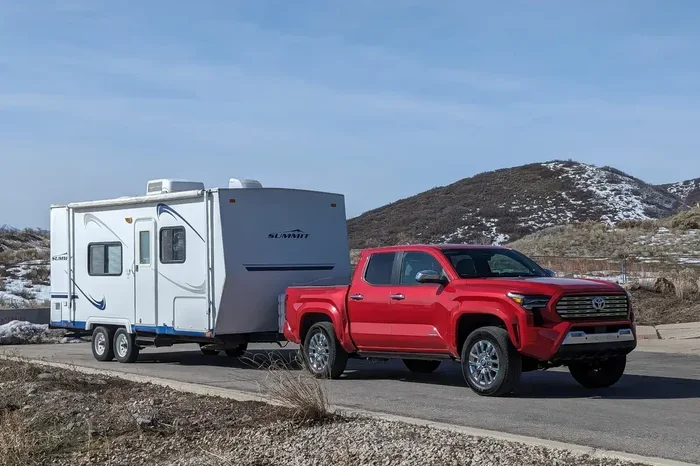
What about a small camper or a medium-sized utility trailer? The 4-cylinder Tacoma can handle these too, but you need to be more careful. A camper that weighs 4,000 to 6,000 lbs is right at the upper limit of the Tacoma’s towing capacity. On flat highways, this works fine. But on steep mountain grades or in hot weather, the 4-cylinder engine may struggle.
One thing that can help is the tow hitch setup. Using the right hitch ball size, weight distribution hitch, and proper wiring can make a big difference in stability and control. If your Tacoma does not have a factory tow package, consider having an aftermarket hitch installed by a professional.
Heavy Trailers and Fifth Wheels
Here is where the 4-cylinder Tacoma hits its limits. Heavy gooseneck trailers, large fifth-wheel campers, and oversized equipment are generally too much for the 4-cylinder engine. These loads often exceed 7,000 lbs and require the torque and power that only a V6 or larger engine can provide reliably.
If you need to tow heavy loads regularly, the V6 Tacoma is the better choice. Trying to push a 4-cylinder Tacoma beyond its limits will cause excessive wear on the engine, transmission, and brakes. It can also create dangerous driving conditions.
Engine Performance and Towing Strain
Towing puts a lot of stress on any engine. The 4-cylinder Tacoma is no exception. Understanding how towing affects your engine will help you avoid damage and stay safe on the road.
How Towing Affects the 4-Cylinder Engine
When you tow a trailer, your engine has to work harder to maintain speed. It has to overcome the extra weight, wind resistance, and friction from the trailer wheels. For a 4-cylinder engine, this means the RPMs stay high for longer periods, which generates more heat and wear on internal components.
Over time, repeated heavy towing can lead to:
- Increased engine wear: The 4-cylinder runs hotter under load, which can accelerate wear on internal parts.
- Transmission stress: The automatic transmission works harder to shift under load, which can shorten its lifespan.
- Brake wear: Stopping a loaded truck takes more effort, so your brakes wear out faster.
Overheating Risks When Towing
One of the biggest concerns with towing a 4-cylinder Tacoma is overheating. The 2.7L engine has a smaller cooling system than the V6, which means it heats up faster under heavy load. This is especially true in hot weather or when driving through mountainous terrain.
You should definitely keep an eye on your temperature gauge while towing. If you notice the engine running hotter than normal, pull over and let it cool down. Continuing to drive an overheating engine can cause serious and expensive damage. If you want to learn more about how heat affects vehicles, check out this guide on can a car overheat on a hot day for helpful tips on managing engine temperature.
Transmission and Gear Ratios
The Tacoma comes with either a 6-speed manual or a 6-speed automatic transmission. The automatic is generally better for towing because it can shift gears more smoothly under load. The transmission uses different gear ratios depending on the configuration, and some ratios are better suited for towing than others.
If your Tacoma has a towing package, it likely includes a lower gear ratio in the rear differential. This lower ratio gives the engine more pulling power at lower speeds, which is exactly what you need when hauling a trailer. Without this gear ratio, the 4-cylinder engine has to work much harder to maintain speed on inclines.
Towing Safety Tips for Tacoma Owners
Safety should always come first when towing. A 4-cylinder Tacoma can be a great towing machine if you follow the right safety practices. Here are some essential tips every Tacoma owner should know.
Install a Brake Controller
A brake controller is one of the most important towing accessories you can install. It synchronizes the trailer brakes with your truck’s braking system. Without a brake controller, your trailer’s brakes will not engage when you press the truck’s brake pedal, which can cause dangerous stopping distances and jackknife situations.
Most modern Tacomas are pre-wired for a brake controller. You just need to purchase and install the unit. The installation is straightforward and can be done at home with basic tools or by a professional at an auto shop.
Check Your Payload Before Towing
Towing capacity is not the only number you need to know. Payload capacity is equally important. Payload refers to the total weight your truck can carry, including the driver, passengers, cargo in the bed, and the tongue weight of the trailer.
If you overload your Tacoma, you risk damaging the suspension, tires, and frame. You also compromise handling and braking performance. Always add up the weight of everything in and on the truck and make sure it stays within the payload rating listed in your owner’s manual.
Use the Right Hitch and Wiring
Using the correct hitch ball size, weight distribution system, and trailer wiring is essential for safe towing. The hitch should match the trailer’s coupler size, and the wiring should connect your trailer’s lights and brakes to your Tacoma’s electrical system.
Improper wiring can lead to dangerous situations, especially at night or in poor weather. Trailer lights that do not work make it hard for other drivers to know when you are braking or turning. This increases the risk of a collision.
If you are concerned about warning lights on your dashboard while towing, learn more about driving with warning indicators in this article on can you drive with a check charging system warning.
Drive Defensively and Allow Extra Space
When you are towing a trailer, your stopping distance increases significantly. You also have a longer turning radius and the trailer can sway in crosswinds. Always allow extra following distance, reduce your speed on wet or windy roads, and avoid sudden maneuvers.
On highways, stay in the right lane and let faster traffic pass. Towing a trailer changes the way your Tacoma handles, and giving yourself extra time and space to react is the best way to stay safe.
Common Mistakes When Towing with a 4-Cylinder Tacoma
Even experienced Tacoma owners make mistakes when towing. Here are some common errors to avoid so you can protect your truck and stay safe on the road.
Exceeding Towing Capacity
This is the most common and most dangerous mistake. Some drivers assume their truck can handle more weight than it actually can. Exceeding the towing capacity puts extreme strain on the engine, transmission, and brakes. It also makes the truck unstable and harder to control.
Always check the weight of your trailer and cargo before you leave. If you are close to the limit, it is better to make multiple trips or rent a larger truck than to risk damaging your vehicle or causing an accident.
Ignoring Tongue Weight
Tongue weight is the downward force the trailer puts on the hitch ball. Too much tongue weight can lift the front of your Tacoma, reducing steering control and braking effectiveness. Too little tongue weight can cause the trailer to sway dangerously.
The general rule is that tongue weight should be about 10 to 15 percent of the total trailer weight. Use a tongue weight scale to check this before every trip.
Skipping Regular Maintenance
Towing puts extra stress on your Tacoma, which means you need to stay on top of maintenance. Regular oil changes, transmission fluid checks, brake inspections, and tire rotations are all essential. Skipping maintenance can lead to breakdowns and expensive repairs, especially when you are on the road far from home.
One accessory that many Tacoma owners overlook is a roof rack or cargo carrier. If you need extra storage space, you can add a roof rack to your Tacoma. For trucks without factory roof rails, there are aftermarket solutions available. You can learn more about installing a roof rack in this guide on can I put a roof rack on a car without rails.
4-Cylinder vs. V6 Tacoma for Towing
If you are on the fence about which engine to choose for towing, here is a side-by-side comparison to help you decide.
- 4-Cylinder Tacoma: Best for light to medium towing up to 6,500 lbs. Great fuel economy and lower purchase price. Ideal for small trailers, boats, and utility loads.
- V6 Tacoma: Best for medium to heavy towing up to 6,500 lbs as well, but with much more power and confidence. Handles heavier loads with less strain on the engine. Costs more upfront and uses more fuel.
For most casual towing needs, the 4-cylinder Tacoma is more than capable. But if you plan to tow frequently or haul heavier loads, the V6 is worth the investment. The extra torque makes a real difference on the road, and you will experience less engine strain and better overall performance.
Final Verdict
So, can a 4-cylinder Tacoma pull a trailer? Absolutely. The 4-cylinder Tacoma is a capable towing machine for light to medium loads. With the right setup, proper maintenance, and smart driving habits, you can safely haul trailers, boats, campers, and utility loads without any major issues.
That said, the 4-cylinder engine has its limits. It is not designed for heavy-duty towing or frequent hauling of very heavy loads. If your towing needs are modest and occasional, the 4-cylinder Tacoma is a great choice. It offers good fuel economy, reliability, and enough pulling power for most recreational and utility needs.
Before you hit the road, always know your numbers. Check your towing capacity, payload limits, tongue weight, and total trailer weight. Install the right safety equipment, including a brake controller and proper hitch setup. And never push your truck beyond its limits. A little preparation goes a long way toward safe and enjoyable towing experiences.
Your Tacoma is built to work hard and last a long time. Treat it right, respect its limits, and it will serve you well for many towing seasons to come. Happy trails!
Frequently Asked Questions
Can a 4-cylinder Tacoma tow a 5th wheel trailer?
The 4-cylinder Tacoma can tow a 5th wheel trailer, but only up to its maximum towing capacity of around 6,500 lbs. Heavier 5th wheel setups will overwhelm the 4-cylinder engine. Always check the specific weight of your 5th wheel setup before towing, and make sure your Tacoma has the proper hitch and towing package installed.
What is the best year for a 4-cylinder Tacoma for towing?
The newer generations (2016 and up) offer the best towing performance for the 4-cylinder Tacoma. These models come with improved cooling systems, better transmissions, and updated towing packages that make them more capable than older models. Always check your specific model year’s towing specs in the owner’s manual.
Do I need a special license to tow with a Tacoma?
In most states, a standard driver’s license is sufficient for towing within the Tacoma’s rated capacity. However, if your total combined vehicle and trailer weight exceeds certain thresholds (usually 26,000 lbs), you may need a special license. Check your local DMV regulations to be sure.
How does towing affect fuel economy on a 4-cylinder Tacoma?
Towing significantly reduces fuel economy. A 4-cylinder Tacoma that gets around 20-25 mpg without a trailer may drop to 12-15 mpg when towing a heavy load. The smaller engine works harder under load, which burns more fuel. Plan your fuel stops accordingly on longer trips.
Can I tow with a 4-cylinder Tacoma in 2WD or do I need 4WD?
You can tow with either 2WD or 4WD, but 4WD provides better traction on slippery or off-road surfaces. For highway towing on paved roads, 2WD is usually sufficient and offers slightly better fuel economy. Choose 4WD if you plan to tow on unpaved roads, boat ramps, or in adverse weather conditions.
What happens if I exceed the towing capacity of my 4-cylinder Tacoma?
Exceeding the towing capacity can cause engine overheating, transmission damage, brake failure, and tire blowouts. It also makes the truck unstable and harder to control, increasing the risk of accidents. Always stay within the manufacturer’s rated towing limits for safe operation.