The Best 6 Channel Car Amplifier for Crystal Clear Sound
A 6 channel car amplifier delivers powerful, clean sound to every speaker in your vehicle. This guide covers the top models, key features, and installation tips to help you choose the right amplifier. Whether you are upgrading your factory system or building a premium audio setup, you will find everything you need here.
A 6 channel car amplifier is one of the smartest upgrades you can make for your vehicle audio system. If you love listening to music on the road and feel your current setup sounds flat or weak, an external amplifier makes a huge difference. It takes the weak signal from your head unit and boosts it powerfully to your speakers.
But why choose a 6 channel amplifier specifically? The answer is simple. One unit powers all your speakers — front left, front right, rear left, rear right, and one or two subwoofers. This means fewer wires, less clutter, and one clean power source for your entire car audio system. Instead of buying two separate amps, you get full-range multi-channel amplification from a single box.
In this guide, we will walk you through everything you need to know. We will cover what a 6 channel car amplifier does, which features matter most, and how to pick the best one for your needs. By the end, you will feel confident choosing the right amp and getting it installed the right way.
Key Takeaways
- 6 channel car amplifiers power all your speakers: They drive front, rear, and subwoofers from a single unit.
- RMS power matters more than peak wattage: Look for steady, reliable output for consistent sound quality.
- Built-in crossovers save wiring and space: They filter frequencies so each speaker gets the right signal.
- Installation is easier than most people think: With the right wiring kit and basic tools, you can do it yourself.
- Match your amplifier to your speakers: Check impedance and power ratings to avoid damage and get the best performance.
- Top brands like Rockford Fosgate, JL Audio, and Kicker lead the market: They offer proven quality and strong warranties.
- A 6 channel car amplifier is the best value for full-system upgrades: One unit replaces multiple amplifiers.
📑 Table of Contents
- What Is a 6 Channel Car Amplifier and Why Do You Need One?
- Key Features to Look For in a 6 Channel Car Amplifier
- Top 6 Channel Car Amplifiers Compared
- How to Install a 6 Channel Car Amplifier
- Common Mistakes to Avoid When Buying a 6 Channel Car Amplifier
- Expert Tips for Getting the Best Sound from Your 6 Channel Amplifier
- Why a 6 Channel Amplifier Is the Best Value for Full-System Upgrades
What Is a 6 Channel Car Amplifier and Why Do You Need One?
A 6 channel car amplifier takes the low-voltage audio signal from your head unit or factory radio and amplifies it to drive multiple speakers. Each channel sends power to one speaker or speaker pair. With six channels, you can run all the speakers in a typical car or truck setup.
Most vehicles come with a factory radio that has a weak built-in amplifier. It simply does not have enough power to move speakers properly. The result is distorted sound at higher volumes and weak bass. An external car stereo amplifier solves this problem completely.
Here is why a 6 channel amplifier makes sense for most setups:
- Full-system power: Drive all four full-range speakers plus a subwoofer or two powered subs from one amp.
- Cleaner wiring: One power cable, one ground, and one remote turn-on wire instead of two separate amp setups.
- Better signal matching: All channels receive the same quality boosted signal from one source.
- Space savings: One amp takes up less room in your trunk or under a seat than two separate units.
- Cost efficiency: Buying one quality amp often costs less than buying two lesser amps.
Think of it this way. Your head unit is like a faucet with low water pressure. The 6 channel car amplifier is a booster pump that gives you strong, steady flow. Every speaker in your car gets the full pressure it needs to sound its best.
How Does a Multi-Channel Amplifier Work?
Inside a multi-channel amplifier, there are multiple independent amplifier circuits stacked into one housing. Each circuit handles one channel. They share the same power supply but process their audio signals separately. This design keeps each channel clean and prevents interference between channels.
The amplifier receives audio signals through RCA cables connected to your head unit. It then boosts those signals using transistors or MOSFETs. The boosted signal travels through speaker wire to each speaker. A good car audio amplifier does this with very little distortion, keeping your audio fidelity intact.
Key Features to Look For in a 6 Channel Car Amplifier
Not all 6 channel car amplifiers are created equal. Some deliver outstanding sound quality while others focus on raw power. Knowing what to look for helps you avoid a bad purchase and find an amp that truly fits your needs.
RMS Power Rating
The RMS power rating is the most important spec on any amplifier. It tells you the continuous power the amp can deliver without overheating or distorting. Always look at RMS, not peak wattage. Peak numbers are inflated and only last for a fraction of a second.
For a full-range amplification setup with six speakers, aim for an amp that delivers between 50 and 100 watts RMS per channel. This range works well for most factory and aftermarket speakers. If you plan to power a subwoofer on one or two channels, you want higher wattage on those channels.
Total Harmonic Distortion (THD)
Total harmonic distortion measures how clean the amplified signal is. Lower THD means purer sound. Look for a 6 channel car amplifier with THD below 0.1%. The best models on the market achieve THD levels around 0.01% or lower.
When THD is high, your music sounds harsh and fatiguing. You lose detail in vocals and instruments. A low THD rating ensures that every note sounds natural and true to the original recording.
Signal-to-Noise Ratio
The signal-to-noise ratio (SNR) tells you how much unwanted noise the amplifier adds to your music. Higher SNR is better. A good car audio amplifier should have an SNR of 100 dB or higher.
When you turn up the volume on a quiet passage, you should hear music, not a hiss or hum. A strong SNR keeps your system silent when there is no signal and transparent when there is.
Built-In Crossovers
A built-in crossover is a huge convenience in a 6 channel amplifier. It splits the audio signal so high frequencies go to your tweeters and midrange speakers, while low frequencies go to your subwoofers. This process is called frequency filtering.
Without crossovers, you risk sending bass frequencies to small speakers that cannot handle them. This causes distortion and can damage your speakers. Most quality multi-channel amplifiers include adjustable crossovers that let you fine-tune the split for your specific setup.
Impedance Matching
Impedance is measured in ohms and refers to the electrical resistance of your speakers. Most car speakers are 4-ohm or 2-ohm. Your amplifier must be able to handle the impedance of your speaker load.
Check the amp’s minimum impedance rating. A good 6 channel car amplifier handles 4 ohms per channel comfortably. Some models can also handle 2 ohms, which is useful if you plan to wire speakers in parallel for more power.
Amplifier Class
Amplifiers come in different classes, and each has pros and cons:
- Class D: Highly efficient, runs cool, and is compact. Great for most car audio applications.
- Class AB: Offers excellent sound quality but runs warmer and less efficiently.
- Class T: A hybrid design that combines efficiency with good audio fidelity.
For a 6 channel car amplifier, Class D is the most popular choice. It gives you great power in a small, efficient package. However, if audio fidelity is your top priority, a Class AB model may be worth the extra heat and size.
Top 6 Channel Car Amplifiers Compared
The market is full of options, and choosing the right 6 channel car amplifier can feel overwhelming. To help you decide, here is a look at some of the best models available right now.
| Amplifier | RMS Power Per Channel | Total Power | THD | Best For |
|---|---|---|---|---|
| Rockford Fosgate R600X5 | 100W @ 4 ohms | 600W | 0.05% | Balanced performance and value |
| JL Audio VX600/5i | 100W @ 4 ohms | 600W | 0.05% | Premium sound quality |
| Kicker DX600.5 | 100W @ 4 ohms | 600W | 0.05% | Budget-friendly full system |
| Alpine SPC-610M | 100W @ 4 ohms | 600W | 0.05% | Factory system upgrades |
| Skar Audio RP-600.5 | 100W @ 4 ohms | 600W | 0.1% | Value-oriented bass builds |
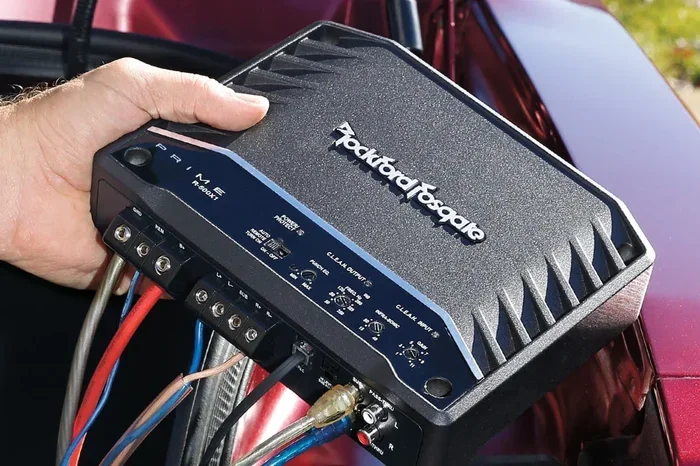
Each of these car audio amplifiers delivers strong performance at reasonable prices. The Rockford Fosgate R600X5 is a fan favorite for its rock-solid build and excellent sound quality. The JL Audio VX600/5i offers slightly more refined audio with exceptional clarity. The Kicker DX600.5 is a great entry point for those on a tighter budget.
The Alpine SPC-610M shines in factory radio upgrades because it includes a built-in signal processor that works seamlessly with factory systems. The Skar Audio RP-600.5 is a solid choice for those who want strong bass response without spending a fortune.
Quick Tips for Choosing the Right Amp
- Match power to your speakers: Your amp’s RMS rating should be close to your speaker’s power handling rating.
- Read real reviews: Look beyond marketing numbers and read what actual users say about sound quality and reliability.
- Check your head unit output: Some head units have higher preamp output voltage, which pairs better with certain amplifiers.
- Consider your wiring kit: A quality amplifier wiring kit includes power cable, ground wire, remote wire, RCA cables, and speaker wire.
- Think about future upgrades: Buy an amp with a little extra power headroom so you can upgrade speakers later without replacing the amp.
How to Install a 6 Channel Car Amplifier
Installing a 6 channel car amplifier might sound intimidating, but it is very doable for most car owners. With basic tools and a little patience, you can have your new amp running in an afternoon.
What You Will Need
Before you start, gather these items:
- 6 channel car amplifier of your choice
- Amplifier wiring kit (power cable, ground wire, remote turn-on wire)
- RCA cables for signal connection
- Speaker wire (12 or 14 gauge recommended)
- Ring terminals and wire connectors
- Wire crimping tool
- Screwdrivers, panel removal tools, and a socket set
- Fuse puller and inline fuse
Step-by-Step Installation Process
Step 1: Disconnect the battery. Always start by disconnecting the negative terminal on your car battery. This prevents any electrical shorts or damage to your vehicle’s electronics.
Step 2: Run the power cable. Route the power cable from the battery to the location of your amplifier. Use an inline fuse within 18 inches of the battery connection. Drill a grommet hole through the firewall if needed to pass the cable into the cabin.
Step 3: Ground the amplifier. Connect the ground wire to a clean, bare metal surface on the vehicle chassis. Scrape away any paint or rust to ensure a solid connection. A poor ground causes noise and poor performance.
Step 4: Connect the remote turn-on wire. This wire tells the amp to turn on and off with your head unit. It usually connects to the blue wire on your factory harness or the remote output on an aftermarket head unit.
Step 5: Run RCA cables. Route the RCA cables from your head unit or factory line output converter to the amplifier inputs. Keep them away from power cables to avoid interference. Use cable ties to secure them along existing wire paths.
Step 6: Wire the speakers. Run speaker wire from the amplifier outputs to each speaker. Pay attention to polarity — positive to positive and negative to negative. Reversed polarity causes sound cancellation and weak bass.
Step 7: Reconnect the battery and test. Turn on the head unit and play music at low volume first. Check that all speakers are working and that there is no distortion. Slowly increase the volume to test for any issues.
Common Installation Mistakes to Avoid
- Using too-thin speaker wire: 16-gauge wire is too thin for most amplifier setups. Use 12 or 14 gauge for best results.
- Ignoring the ground connection: A bad ground is the number one cause of noise and poor performance in car audio.
- Over-tightening terminal connections: This can strip the terminal and create a loose connection over time.
- Placing the amp in a sealed enclosure: Amplifiers need airflow to stay cool. Mount it in a ventilated area.
Common Mistakes to Avoid When Buying a 6 Channel Car Amplifier
Even experienced car audio enthusiasts sometimes make mistakes when choosing an amplifier. Avoiding these common errors saves you money, time, and frustration.
Focusing Only on Peak Power
The biggest mistake most people make is chasing peak wattage numbers. A 6 channel car amplifier rated at 900 watts peak sounds impressive, but that number means nothing in real-world use. Always look at the RMS power rating per channel. That is the number that tells you what the amp can actually deliver continuously.
Ignoring Speaker Compatibility
Not every amplifier works well with every speaker. If your speakers are rated at 4 ohms and your amp struggles at 4 ohms, you will get distorted sound and potential damage. Always check that your amplifier’s impedance rating matches your speaker setup.
Skipping the Crossover Setup
Many people plug in their 6 channel amplifier and leave all crossovers at default settings. This is a missed opportunity. Adjusting your crossovers properly ensures each speaker reproduces only the frequencies it was designed for. The result is cleaner, louder, and more accurate sound.
Buying the Cheapest Option
It is tempting to grab the cheapest car stereo amplifier you can find, but ultra-budget amps often have high THD, poor build quality, and unreliable power supplies. Spending a little more on a reputable brand pays off in sound quality and longevity.
Forgetting About Your Head Unit
Your amplifier is only as good as the signal it receives. If your head unit has a poor preamp output or high distortion, your entire system suffers. Consider upgrading your head unit or adding a line output converter if you are keeping your factory radio.
Expert Tips for Getting the Best Sound from Your 6 Channel Amplifier
You have your new 6 channel car amplifier installed and everything is working. Now it is time to fine-tune your setup for the best possible sound quality. These expert tips make a noticeable difference.
Set Your Gain Properly
The gain control on your amplifier sets the input sensitivity. Setting it too high causes distortion and can damage speakers. Setting it too low leaves power on the table. The proper way to set gain is to play a familiar track at your listening volume, then slowly increase the amp gain until you just barely hear distortion, then back it off slightly.
Use Sound Deadening Material
Vehicle audio upgrade is not just about the amplifier. Road noise and panel vibrations degrade your sound quality significantly. Adding sound deadening mats to your doors, trunk, and floor reduces resonance and lets your speakers perform at their best.
Position Your Speakers Correctly
Even the best car audio amplifier cannot fix poorly positioned speakers. Make sure your front speakers are aimed toward the listener’s ears. Use kick panel mounts or shelf mounts for the best imaging and staging.
Keep Your Wiring Clean and Organized
Neat wiring is not just about looks. It prevents wires from vibrating and creating noise. It also ensures good electrical connections that last for years. Use zip ties and wire loom to keep everything tidy behind your panels.
Break In Your Speakers
New speakers and amplifiers sound better after a break-in period. Play music at moderate volumes for 20 to 30 hours before making final tuning adjustments. You will notice the sound opens up and becomes smoother over time.
Upgrade Your Power Supply if Needed
If you notice your lights dimming when you play bass-heavy music, your electrical system may be struggling. Consider adding a capacitor or upgrading to a high-output alternator. This ensures your 6 channel car amplifier always gets clean, stable power.
Why a 6 Channel Amplifier Is the Best Value for Full-System Upgrades
If you are serious about improving your car audio system, a 6 channel car amplifier is the most cost-effective way to do it. Instead of buying two separate amplifiers — one for your full-range speakers and one for your subwoofers — one six-channel unit handles everything.
The power output of a modern 6 channel amplifier is more than enough for most factory speaker upgrades. You get clean, powerful sound across all six channels without the complexity of managing multiple amps. The built-in crossovers, remote level controls, and compact designs make these units incredibly versatile.
For car owners who want to transform their daily driving experience from mundane to musical, a 6 channel car amplifier delivers exactly that. The difference in sound quality is immediate and dramatic. Vocals become clearer, instruments gain definition, and bass becomes tight and controlled instead of muddy and boomy.
Whether you drive a sedan, SUV, truck, or compact car, there is a 6 channel amplifier that fits your system and your budget. The key is matching the right amp to the right speakers and taking the time to install and tune it properly.
Take the time to research your options, read reviews, and understand your speaker specifications. A well-chosen 6 channel car amplifier will serve you well for years and make every drive more enjoyable. Your ears will thank you every time you turn the key and hit the road.
Now that you understand the ins and outs of 6 channel car amplifiers, you are ready to make a confident choice. Pick the model that fits your needs, gather your tools, and get ready to experience your music the way it was meant to be heard.
Frequently Asked Questions
What does a 6 channel car amplifier power?
A 6 channel car amplifier can power up to six speakers independently. Most people use it to run four full-range speakers (front and rear) plus one or two subwoofers. This gives you complete control over your entire vehicle audio system from a single amplifier.
How much power does a 6 channel amplifier need for a stock speaker upgrade?
For most factory speaker upgrades, 50 to 75 watts RMS per channel is plenty. This provides enough power to make your speakers sound significantly better without overpowering them. If you have high-performance aftermarket speakers, aim for 75 to 100 watts RMS per channel.
Can I bridge channels on a 6 channel amplifier?
Yes, many 6 channel car amplifiers allow you to bridge channels. Bridging combines two channels into one, doubling the power output for a single speaker or subwoofer. However, bridging reduces the total number of channels available, so plan your setup carefully.
Do I need a capacitor with a 6 channel amplifier?
A capacitor helps stabilize voltage when your amplifier demands sudden bursts of power, especially during bass-heavy passages. For most setups with a single 6 channel car amplifier, it is not strictly necessary. But if you notice dimming lights or hear your amp going into protection mode, a capacitor can help.
What is the best way to connect a 6 channel amplifier to a factory radio?
The easiest method is to use a line output converter (LOC). The LOC taps into the factory speaker wires and converts the high-level speaker signal to a low-level RCA signal. You then run RCA cables from the LOC to your car stereo amplifier. This setup preserves your factory radio while adding premium sound quality.
How long does it take to install a 6 channel car amplifier?
A straightforward installation typically takes 2 to 4 hours for someone with basic car audio experience. If you need to run new wiring, add a line output converter, or modify your dash panel, it may take longer. With patience and the right tools, most people complete the job in a single afternoon.
=== CONCLUSION ===
A 6 channel car amplifier is the ultimate upgrade for anyone who wants better sound in their vehicle. It powers all your speakers with clean, consistent energy and transforms your daily commute into a premium listening experience. From RMS power ratings to built-in crossovers, understanding the key features helps you choose the right amp with confidence.
Whether you pick the Rockford Fosgate R600X5 for its balanced performance, the JL Audio VX600/5i for refined audio quality, or the Kicker DX600.5 for budget-friendly value, you are investing in your car audio system that will pay off for years. The difference in sound quality is immediate and noticeable.
Take your time, match your amplifier to your speakers, and follow proper installation practices. Your 6 channel car amplifier will reward you with crystal clear sound every time you turn the key and hit the road.